E-newsletter of the Counselling Department · Vol. VI · July 2021 · Guru Purnima Edition
Anthar Dhwani
the e-newsletter of the Counselling Department, Sri Sathya Sai Institute of Higher Medical Sciences, Whitefield.
- Issue
- Vol. VI · July 2021 · Guru Purnima Edition
- Published by
- Counselling Department, SSSIHMS, Whitefield
- In this issue
- 9 sections · 33 pictures
- Print edition
- 16 pages
← Previous: Vol. V · January 2021 · HopeNext →: Vol. VII · January 2022
Anthar Dhwani · pages 2–3
EDITORIAL
This new decade which commenced in 2020 has ushered in a troubled world. The centre stage belonged to the Covid pandemic and the collateral damage arising from it like mental health, widening of the existing gap between the haves and the have-nots, etc. Simmering issues the world over have reached the flashpoint and their outbursts are beginning to take their toll. Swami’s prophetic words are very contextual in this regard. During Dasara celebrations in Prasanthi Nilayam in the year 1976, Swami in His Divine Wisdom had these words to say in His inaugural discourse on the first day of the Navarathri festival.
“The world today is facing manifold problems due to modern civilization. The world has become smaller due to the development of transport and communication facilities. The boundaries between various countries have narrowed down. Today,the problems and difficulties in a particular country are not confined to that country alone. Instead, they are spreading to the whole world like a wild fire and making the world tremble under its impact. The position of man today can be compared to a situation where there is everything that man can wish for in this objective world, but he lacks in mental peace and happiness.
Modern man is under the illusion that peace and happiness are outside and is therefore searching for them in the outside world.. Unable to realise the truth that he himself is an embodiment of peace, man is trying to search for peace in the outside turbulent world. Man is fighting for his rights, forgetting at the same time his duty towards his fellow human beings and his country.”
Forty five years have gone by. Is the world any different today? Sad to say things have worsened. In this pandemic situation the human mind has played a very detrimental role. However ironically, the same mind can be harnessed to produce the opposite effect, leading from darkness to light. Swami has repeatedly quoted that “the mind alone is the cause of either bondage or liberation” and He says ‘the easiest and best way to control the mind is through love’.
Love is the universal panacea for this troubled world and the role of the mind to bring about change is the theme for this Guru Purnima issue of AntharDhwani. The articles here reflect and elaborate on this with thought provoking case studies to illustrate the importance of love and the role of the mind in every individual’s life. That Swami’s love for humanity and His Sankalpa always prevails is succinctly brought out in the article ‘Efficacy of Tele-Counselling’, a heartwarming story of how love comes and grows.
Jai Sai Ram.
The Editorial Team
(Contact person: Umesh Rao <counsellingblr@sssihms.org.in>)
Anthar Dhwani · pages 3–4
Divine Love must flow throughout the world
Swami’s Message on Guru Purnima, 29th July 1988.
“Man's foremost duty is to make the stream of Divine Love flow throughout the world. It is not for living for himself that every man has been born. Only by having the noble thought that he has to serve the society, will he ennoble himself and achieve self-satisfaction. Of what avail is human birth if you cannot get rid of narrow feelings and resolve to serve all mankind? What greater message can the Guru give?
Forgetting his inherent eternal divinity, man today regards life as intended only for the pursuit of selfish aims. It is this divinity that should be manifested in man's life. However, man today is caught up so much in selfish pursuits that he has degraded himself to the level of animals and is displaying demonic traits. In this situation, what is it that man should seek? How can he attain peace and happiness? The first requisition is the cultivation of the love of God. The Puranas and the ancient sages have declared that the Divine incarnates to punish the wicked and protect the good. This is not correct. The Divine incarnates to inculcate love in mankind and teach how love should be promoted and practiced. Only when such love is developed will man be free from sorrow and trouble. Sins will be wiped out and fear will cease to haunt men. Where there is the love of God, there will be fear of sin. When both of these are present, society will experience morality.
Therefore, it is essential to cultivate the sense of ekatwa (oneness). Love alone signifies that oneness. For this love, there is no path, no reward, no discipline other than love itself. The more you develop this love the more you experience bliss. Today love is cribbed and confined. It is limited to one's kith and kin. Our love should transcend these narrow limits, embrace the whole world and extend love to every living being. Love is present in everyone in varying degrees.
Realise the importance of unity. You must develop fraternal feelings, without regard to barriers of race, religion, caste and class. When you develop this sense of spiritual kinship, the nation will progress and prosper. The essence of all religions, all teachings and spiritual paths is only one thing: Love. Develop that Divine Love. Above all, whatever your difficulties, whatever the ordeals you have to undergo, in any situation "Do not give up God and realise God is One."
- - Extracted from Swami’s Discourse on Guru Purnima, 29th July 1988.
Om Sri Sai Ram
FROM THE DIRECTOR’S DESK
The present times have been extremely stressful for people in general. Apart from patients and their families suffering anxiety, illness and bereavement, the frontline workers including nurses, doctors, housekeeping and paramedical staff have been constantly exposed to the danger of infection, stress of long hours of duty in protective suits and mental anguish dealing with deteriorating and dying patients.
Apart from providing physical resources like adequate protective equipment, food and hydration to tolerate hot environments and moderating duty hours, psychological support and encouragement has been invaluable in seeing us through the worst of these difficult times.
Inspired by Bhagawan Sri Sathya Sai Baba, the couselling team of our hospital has been constantly available to talk to patients, relatives or staff to allay their anxieties and give them a feeling of strength and solace. The use of tele-counselling has been the most valuable technical tool to enable the continuation of these services even when physical proximity is not possible due to the compulsions of the pandemic.
“No one cares how much you know until they know how much you care.” – Theodore Roosevelt
At no time has the truth of this statement stood out so vividly than now when no one knew for sure about how best to treat and support patients at the time of the pandemic with a new disease. Although knowledge grew and was being brought into practice each day, there was great amount of uncertainty, fear, anxiety and stress for all.
Science has done well to offer new solutions such as medications and the development of vaccines, but we felt helpless in many situations where despite all known methods, we could not cure or preserve life. For both patient and caregivers it became very essential to know the second part of the statement, the knowledge that someone cared and therefore the reassurance that the best available knowledge would be applied to help allay the situation.
Conveying this assurance needed something more than the routine conversation or the communication of information. This need was filled by expert counselling.
I am grateful to Swami and to our counselling team for having been there for all of us during these difficult times. They have helped us to cope and perform and thereby to meet the challenges that were put before us.
Anthar Dhwani · page 5
“There is only one religion, the religion of Love”
Love as thought is Truth, Love as action is Righteous Conduct, Love as feeling is Peace, Love as understanding is Non-Violence. Love is selflessness, Selfishness is Lovelessness. Love gives and forgives, Selfishness gets and forgets. Sathya Sai Baba - Sathya Sai Speaks Vol.5/Ch.38
Love is patient, love is kind. It does not envy, it does not boast, it is not proud. It does not dishonour others, it is not self-seeking, it is not easily angered, it keeps no record of wrongs. Love does not delight in evil but rejoices with the truth. It always protects, always trusts, always hopes, always perseveres. Love never fails. Corinthians 13: 4-8
“Your task is not to seek for love, but merely to seek and find all the barriers within yourself that you have built against it.” Rumi
Anthar Dhwani · pages 6–8
HUMAN VALUES IN SAI COUNSELLING
Swami’s Message:
Conflicts and factions, violence and upheavals are caused by the neglect of human values in daily life. Man becomes fit and functionally valid only when, along with scholarship and expert skills, he has imbibed these values. The person who is wedded to Truth and Love would need nothing more for peace and happiness. When Creation is witnessed through these values, it becomes holy scripture, an inspiring lesson and guide. Therefore, I exhort you: Let Truth and Love be the goals for all your efforts and studies.
- - Divine Discourse to Students of the Prasanthi Nilayam Campus at the Institute Auditorium, on Dec 5, 1985.
Swami has stressed on the role of human values in many discourses and writings. The values of Sathya, Dharma, Ahimsa, Shanti and Prema guide the thinking process of an individual leading to rightful actions in life. It influences the overall well-being of the person. Loss in any one or more of the human values, weakens a person. Time and again the counsellors have observed this pattern. Just like the deficiency of any vitamin or mineral causes illness in the body, deficiency in any of these human values in life, negatively impacts the mind.
It is well accepted fact in the medical community that mind plays a very important role in the well-being of a person. A weak mind harboring negative thoughts can aggravate existing illness and/or delay recovery. On the other hand, a positive mindset can put one on fast path to recovery. This is exactly what happened in the case of a neuro patient, Vijaya Palepalli. This article traces the role of human values in the remarkable self-transformation of the patient.
Brief summary of the case study
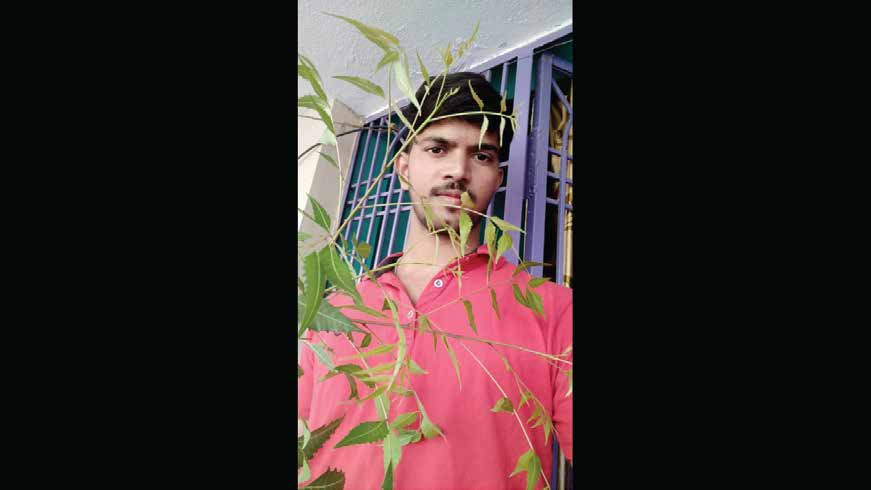
Vijaya Palepalli, a 23-year old suffering from neuro fibroma, came to SSSIHMS Whitefield in November 2019. When he first came to the counselling department, he looked sad and tense. He comes from a family of farm laborers. He has 3 older sisters and a younger brother. By the age of 13, he lost both his parents and quit school to work at a dairy farm. As the siblings did not have much family or financial support, they took up odd jobs to keep the house running. Around 3 years back, Vijaya developed back pain which soon deteriorated. He had to quit his job. His sister and brother took him to hospitals in Tirupati and Bangalore. The prescribed medicines were not helping anymore. He was often found brooding and was neither sleeping nor eating properly. The doctors in SSSIHMS suggested surgery. He expressed his anger and dejection, as he narrated his life experiences. To him, his life was nothing but a series of hardships and challenges since childhood. After guiding him through the relaxation therapy, I encouraged him to look at the positive aspects in his life. The strong bond amongst the five siblings and their support in the last two years when his mobility declined, clearly showed they cared for him. Vijaya agreed. His sister and brother pooled money for his hospital trips and medicines. With the new point of view, he prayed for himself as well as his siblings. Before leaving, Vijaya asked for a selfie with me, which seemed strange and I politely refused.
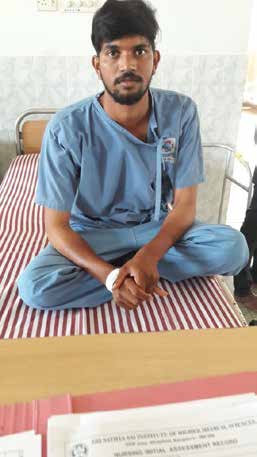
Three months later, in February 2020, Vijaya returned for surgery accompanied by his younger brother, Kallesh. I was able to connect with Vijaya over phone when he was in the pre-op ward. He recognized my voice and told that he had been practicing what he learnt in the counselling session and came mentally prepared for the surgery. But he just got to know that a second surgery might be required if the tumor could not be removed completely in one go. The brothers were now nervous and rethinking the surgery that was scheduled for the next morning.
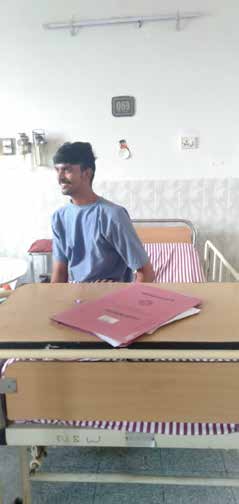
I listened to their fears and reminded them to think positively. The reassurance that they were in good hands calmed them down. Before ending the phone call, Vijaya confessed that he asked for a selfie when we met, as I reminded him of his mother. The surgery was successful without a need for a second one. Through the next couple of days, the brothers kept in touch with me sharing their small fears and doubts. Vijaya recovered well and was scheduled for discharge. With special permissions, I was able to visit him in the discharge ward.
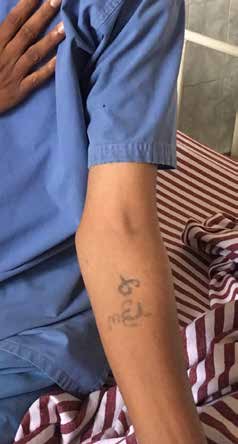
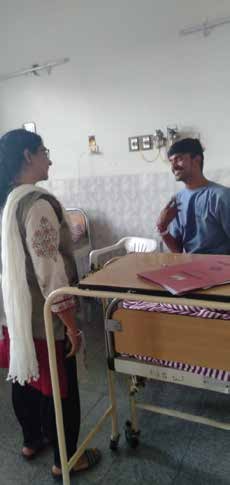
There was noticeable improvement in his physique since we first met in November 2019. Vijaya was overjoyed at the surprise visit and excitedly demonstrated his limp-free walk. He shared details of the surgery, his future plans and also childhood memories. He showed photos of his parents and a childhood tattoo on his arm.
I was amazed to see “Amma” tattooed in Telugu. He loved his mother very much and one day on the way back from school, he got the tattoo. When he showed it to his mother, she told him “Keep amma in your heart, not just on the arm”. He was 12 years old then. A few months later his mother passed away. Remarkably, Vijaya narrated this incident with a sense of pride and sentiment as can be seen in the picture.
A positive outcome in a patient motivates a counsellor to analyze and understand the contributing factors. The change in Vijaya’s emotional state, since his first visit through the day of discharge to full recovery is dramatic as can be seen in the photos. It was only in the last meeting, that the depth and intensity of love for his mother was uncovered. While it is evident that the key to Vijaya’s transformation was the love for his mother, the underlying mechanism had to be studied. Can love really bring such a change? Consider this, on a typical day we meet, say a dozen people out of whom, we may manage to talk lovingly to at least a handful. Is there any significant change in them? Are we able to ‘touch’ them?
Love versus Prema
Let us explore the term love, from a different angle. If you were asked to describe your mother’s love, different adjectives from kind, affectionate, patient, selfless to courageous would flow out. Along with them will also come mental images that have been imprinted from our childhood. Would these adjectives and mental images, all put together, sufficiently describe one’s mother? A group of people led through a similar activity, unanimously responded that words and memories could not fully capture the essence of their mother’s love. Why so? Mother’s love is all of these and more. Like they say, the whole is greater than the sum of the parts. Feelings, emotions and memories are of the mind. Pure love is not merely of the mind. It is from a deeper source and transcends the mind and body. It exists at the level of Spirit or soul. This highest form of love is what is referred by Prema. Often the term love is misused and overused. It is used interchangeably with liking or attachment. For example: “I love blue color”, “I love ice cream”. Liking and attachment are of the mind. Prema is synonymous with Pure Love or Universal Love or Unconditional Love or All-encompassing love or the All-pervading life energy. Mother’s Love is frequently used an example as it is easy to relate to, but it is not the only form of unconditional Love.
Self-Transformation brought about by Prema
In Vijay’s case, Mother’s love was not merely a happy childhood memory. During the first session there was a profound moment when he was reminded of his mother. Dr.Leijssen describes this as a “Sacred Experience” and the process as “connecting with a larger whole” (Leijssen, Mia. “Psychotherapy at the soul level”,2009). Below is an analysis of events leading to Vijaya’s recovery and the corresponding change in the human values.
- A tiny spark lit by his mother’s memory, connected him to his inner source. Associated with this change is the human value of Prema that he had for his mother.
- It rekindled an innate desire for personal growth. Carl Rogers terms it “actualizing tendency”. (Rogers, Carl. “On becoming a person: a therapist's view of psychotherapy”, Constable, 1967, London). Under the guidance of the counsellor, Vijaya started to see the positive aspects in his life. His feelings of anger and
sorrow were replaced with gratitude towards his siblings. This shift can be attributed to recognizing the Sathya.
He connected to his inner strength and pulled himself out of self-pity. This change can be associated with the human value of Ahimsa. Dejected by the current illness and brooding over past hardships, he got into a state of self-pity which resulted in poor appetite and sleep. With his negative self-talk, he was causing harm or “himsa” to himself. Self-love is a form of Ahimsa, which is to care for one’s own well-being, i.e. caring for own’s one body, mind and spirit.
- He realized that he doesn’t have to suffer and can change his life. He took charge of his life and made healthy choices. Associated with this shift is the human value of Dharma. It is one’s duty to take care of oneself. Only Vijaya knew his innermost thoughts and needs. After returning home, he took necessary steps to undo the damage. He practiced the relaxation technique regularly and kept negative thoughts away. His eating and sleeping pattern improved.
- The cumulative result of the above changes is Shanti.
Clearly the shift triggered by Prema, strengthened the values of Sathya, Ahimsa and Dharma, guiding him to make suitable alterations in his life style. The changes culminated in Shanti or peace of mind which is a pre-requisite for healing.
Of these five vital principles, Love is the foremost. It is Love that flows as the under-current for the other four values. — Sri Sathya Sai Baba, Divine Discourse on Ugadi, Prasanthi Nilayam Mandir, 22 March 1985.
My Learnings
For a counsellor, there is something to learn from every patient session. Personally, observing Vijaya’s transformation was an enriching experience. My learnings from this case study are as listed below.
Conducive Environment: The analysis brought out one point strongly, which is the importance of a conducive environment in a counselling session. In a conducive environment the patient or caregiver can touch something bigger, higher and larger than oneself that triggers healing. In that space, the patient can self-introspect, draw on his inner strength and chart a course for recovery. Also note, healing originates in the mind. The minute one chooses to get better, healing begins and not necessarily after a doctor consultation or treatment.
How to create such an environment? Often Umesh Uncle reminds us, counselling is not advising, it is not talking. Gita Aunty says, “Expand your heart, Let Swami’s energy flow”, which is to create this conducive environment. How can energy flow? Is there an ON/OFF switch? We know Electricity flows through a good conductor. In case of humans, to be a good conductor, means to have a pure heart. Is it a coincidence that the Five Human values ultimately lead to that, a pure heart? Carl Rogers conditions for therapeutic change namely, Psychological Contact, Unconditional Love, Empathy, Congruence are all covered by the 5 Human Values. By aligning with the core human values, SAI counsellors can become good conductors of that Pure energy and can create conducive environment for a patient.
State of being: It is not a counsellor’s presence or appearance, but the state of their being that matters. A counsellor’s state of being has a significant bearing on what a patient-caregiver perceives. It will lead the counsellor’s body language, thoughts, questions, tools, suggestions and flow of the session. The various terms used by psychotherapists: state of unconditional love, state of unconditional positive regard, state of equanimity, state of balance, state of awareness or state of unconditional acceptance – more or less point to this state of being.
What should be the goal of a SAI Counsellor? The goal of a SAI counsellor should be to get that state at will. The next step, would be to get there, consistently. Spiritual masters, saints, yogis and prophets are always in that state, which explains the aura or energy around them. That would be the ultimate goal of a spiritual seeker. Easier said than done, getting to this mindset requires effort and constant practice. Just as in the case of an athlete, a singer, a dancer, a writer or a scientist, the preparation requires conviction and commitment. It involves, being aware of one’s thoughts, changing old thought patterns, regularly clearing mental space, periodic self-introspection and self-evaluation. It is a tall order to fill and the practice should continue till the pure state of being becomes like second nature.
To conclude, this case study brought out the role of human values in the self-transformation of a patient. Additionally, it shows how aligning to human values strengthens the qualities required of a SAI counsellor. In SAI counselling we believe that under the loving guidance of a counsellor, a patient/caregiver is capable of identifying the root cause of their emotional disturbance. This holistic approach empowers the patient/caregiver to take corrective actions to regain balance in life.
Jai Sai Ram........................................................................................................................................................................................
Contributors - Wednesday Team SAI Counsellors - Jaya Tadimeti (Lead Counsellor), Mallika C.R, Sumana Yadalam, Subha Srinivasan and Manisha Bardoloi, Department of SAI Counselling, SSSIHMS, Whitefield.
Anthar Dhwani · page 9
SAI TELE-COUNSELLING FACTS AND FIGURES
Tele-counselled patients (language wise) January to June 2021 | Total- 1261
Jai Sai Ram........................................................................................................................................................................................
Contributors: SAI Counsellors Radhika Yadalam, Haritha Rao. Department of SAI Counselling, SSSIHMS, Whitefield.
Tele-counselled Patients Neuro and Cardiac | Total- 1261
Bengali
Hindi
Kannada
Tamil
Telugu
Malayalam
Total Cardiac Adults
Total Cardiac Paediatric
Total Neuro Adults
Total Neuro Paediatric
Anthar Dhwani · pages 10–11
EFFICACY OF SAI TELE-COUNSELLING
“When one door of happiness closes, another opens; but often we look so long at the closed door that we do not see the one which has been opened for us.― Helen Keller
Amidst world wide uncertainty caused by the pandemic we had no choice but to close the Counselling department. With a heavy heart we locked the shrine of our department, which had been a haven of peace and joy to the counselling family and the patients and their family. We prayed to Swami to open another door for us to continue our service as counsellors.
EFFICACY OF TELE COUNSELLING
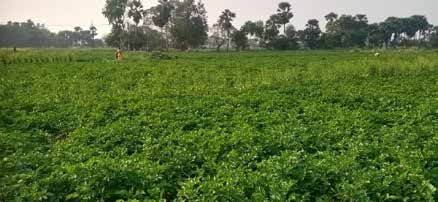
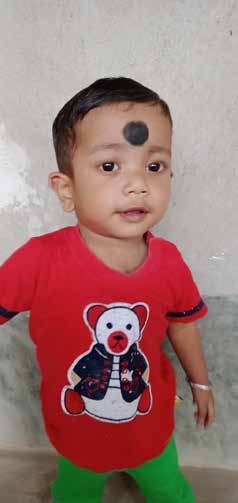
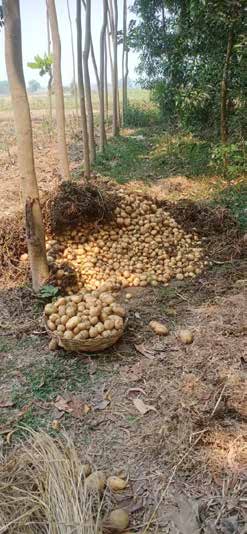
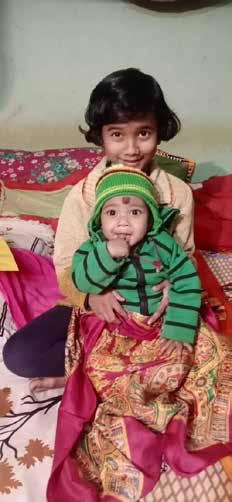
Nine month old Tuhin Samatha’s treatment at SSSIHMS for a congenital heart disease began on 8-2-2020. Tuhin’s parents hail from West Bengal. His father is a farmer and their happiness of being blessed with a son was short lived when they realized he had a serious congenital heart disease.
His parents needless to say, were heartbroken but found an answer to their prayers at SSSIHMS.
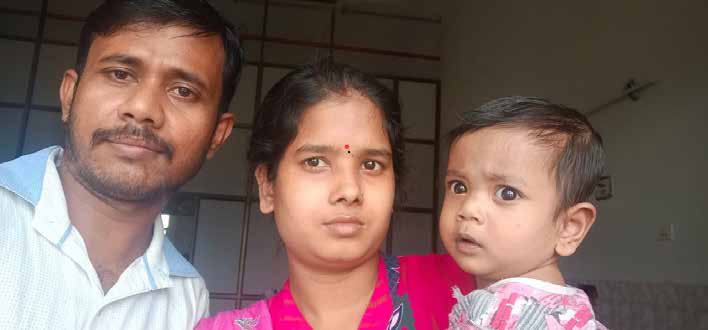
LANGUAGE OF THE HEART
The first interaction with the counsellor, over the phone, in their own mother tongue, was a great relief to Tuhin’s parents. His mother unburdened her sorrow to the counsellor.
The follow up sessions during their stay filled the parents with hope.
On the day of surgery the father called the counsellor seeking special prayers for Tuhin. Both parents seemed to have benefitted from the day of surgery tele session. They were at their most vulnerable state at this point and having the support of the counselling session reassured them. The fact that they could contact a telephone number when they needed someone to listen to them, filled them with a sense of security. This additional service available to them at SSSIHMS was of immense value to Tuhins parents.
CONVERSATION OVER THE TELEPHONE
As tele counsellors the team wondered if one could express genuineness, love and a care over the phone? The experience of tele counselling over the past year has blessed us with new learnings and confidence and has brought about good results.
We can say with conviction, that the same warmth and psychological contact is being established through the medium of the telephone.
Patients who have smartphones eagerly send voice messages, pictures and videos of their patients progress. Others call the counsellors to share their happiness and anxiety.
The training program in tele counselling has equipped SAI counsellors to communicate with Love and listen with compassion.
Tuhin’s Parents Love alone confers lasting happiness and peace. Sharing can alone reduce grief and multiply joy. People are born to share, to serve, to give and not to grab.
- Sathya Sai Baba
EFFICACY OF COUNSELLING
Tuhin was discharged after a successful surgery and his parents continued to stay in touch with the counsellor whom they had never met.
Regular update of Tuhin’s progress and wellbeing is communicated over the phone through voice messages and pictures posted on WA.
The outcome of the post op follow up sessions with the cardiac surgeon is shared spontaneously by the parents over the phone.
When the second wave of Covid 19 affected the state of Karnataka Tuhins parents were very concerned for the counsellors well being. Their call and endearing way of speaking with love and concern enquiring about the counsellor with these words “Maa tumhi Kaymon aache? Baalo Thaakhbey” “Mother, how are you? Remain well” was a heartwarming experience. Proof that the energy of love can be exchanged and meaningful connections established without meeting the patients or their family face to face.
Jai Sai Ram........................................................................................................................................................................................
Contributor: Gita Umesh, HOD, Department of SAI Counselling, SSSIHMS, Whitefield.
Prosperous Season Bountiful Harvest
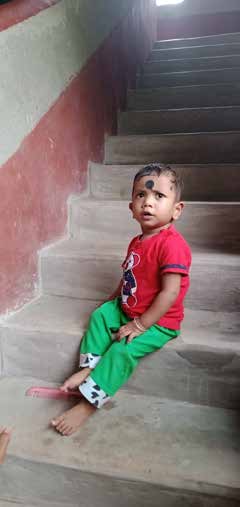
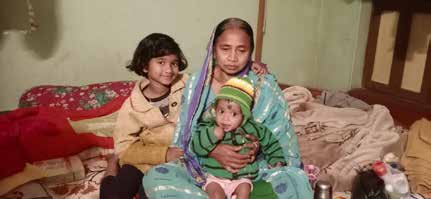
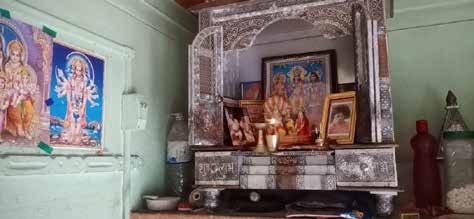
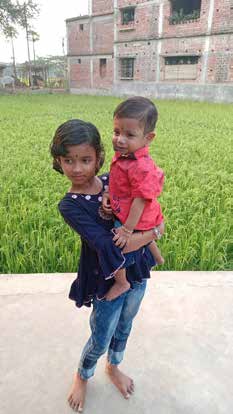
Active Shrine in Tuhins Home Tuhin, His Grandmother and Sister
Love and Secure
Healthy and Strong Growing Up Together
SWAMI’S GUIDANCE ‘LOVE ALL SERVE ALL’ IS THE FOUNDATION OF SAI TELE COUNSELLING SESSIONS
Anthar Dhwani · pages 12–13
SWAMI’S LUCID TREATISE ON THE NATURE OF THE HUMAN MIND
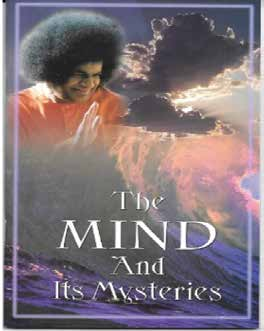
Prescribed reading for SAI Counsellors, Department of Counselling, Sri Sathya Sai Institute of Higher Medical Sciences, Whitefield, Bangalore.
A COMPILATION BY N.KASTURI OF NINE NAVARATHRI
DISCOURSES BY SWAMI DURING DASARA 1976.
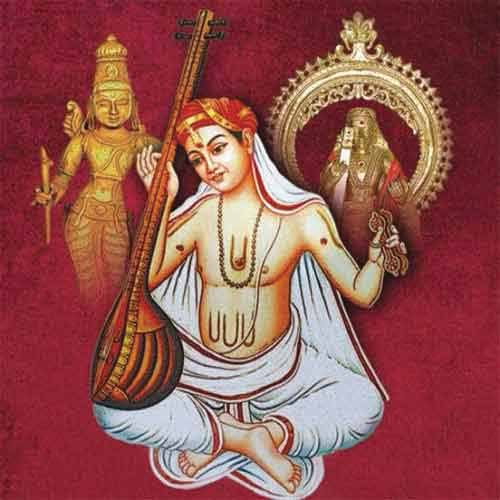
“Mana eva Manushyanaam Karanam Bandha Mokshayah, the mind is responsible either for bondage or liberation. When the mind is turned towards God, it will help attain liberation. On the other hand, when it is turned towards Prakrithi (nature), it will bind you to the nature.
All that we experience in the objective world are reflections of the mind. If there is no mind, there can be no world at all!
Fear, anxiety and such other distortions of human behaviour are the result of external influences. The first step in this Sadhana is to control the outer or external senses - ‘Dama’. The mind plays an important role in this context.”
~ Baba ~
Cultivate Good Thoughts, Feelings and Desires. “Whatever the mind contemplates upon, the inborn impulse of the same will be retained in the Hridaya in the shape of Vasanas (tendencies). This is the experience of every human being, who is unique in God’s creation. The thoughts, feelings and impulses of the present form the basis for the future of a human being. Hence, if somebody wishes to lead a life of peace and security in future, it is necessary that he should cultivate good thoughts, feelings and impulses now. The basis for all the emotions and agitations of the mind is Apeksha -expectation or desire for worldly objects”.
~ Baba ~
"Santhamu leka Soukhyamu ledu" Saint Thygaraja
(WITHOUT PEACE THERE CAN BE NO HAPPINESS)
“THEREFORE, PEACE IS MOST
ESSENTIAL FOR A HUMAN BEING. THAT IS HIS VERY
LIFE - BREATH”. ~ BABA ~
Reduce Your Desires To Achieve Manonasanam
“A cart cannot move by itself. For the cart to move, the bullocks are to be yoked to the cart. And, those bullocks must have been trained to pull the cart. Our Anthahkarana (Inner consciousness) is comparable to
this cart and our mind and intellect to the two bullocks. It is only when these two bullocks are trained in Sathya (truth), Dharma (Right conduct), Santhi (peace) and Prema (love), the cart of our Anthahkarana can reach its destination safely.
The easiest and best way to control the mind is through love. When you realise the truth that the same Atma Thathwa permeates every individual and adopt the principle “Love thy neighbour as thyself”, the mind will not trouble you.”
~ Baba ~
Happiness And Sorrow Are The Making Of One’s Own Mind. Man today believes that joy, sorrow and difficulties are caused by someone else. This is nothing but his delusion. They are the manifestation of one’s own mind.
The Purpose of Religion Is To Regulate The Mind. “There is only one religion - the religion of love and there is only one caste, the caste of humanity.” Once you realise the truth that people of different faiths are only part of the same Paramatma, there will be no scope at all for differentiation on the basis of religion, caste, race, etc., or for jealousy and hatred.
Sublimate Your Intellect And Develop The Power Of Discrimination. The intellect which is the exclusive privilege of a human being among God’s creation, brings lustre to the human life. The Manavathwa (human quality) develops in direct proportion to the blossoming of the intellect. As the Jnana (wisdom) increases the quality of human life unfolds. Hence a man of wisdom is expected to sublimate his intellect and develop the power of discrimination.
These two case studies lucidly illustrate how the human mind which can hold one captive with ones’ fears and anxieties, can also be the key to liberation. Love, adhering to your innate values and surrender to God are instrumental in controlling the mind paving the way for peace and happiness.
Anthar Dhwani · pages 13–14
CASE STUDY 1
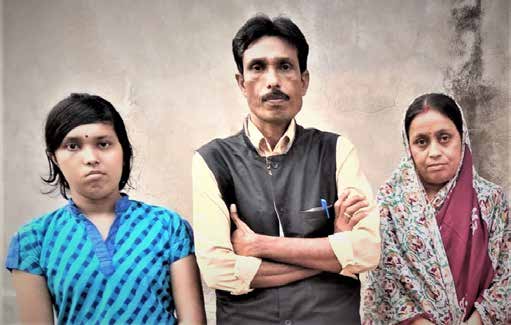
Suvra Ghatak, a 21 years old unmarried girl hailing from Tilgram village, Burdwan Dt. W.B was treated successfully for a brain tumour in our hospital during October 2020. Her father Ashok Ghatak ran his own tailoring shop assisted by his elder daughter, while his wife Malarani managed the home.
Their small world was turned topsy turvy by Suvra’s illness. Five years back when Suvra was in 9th standard, she started developing headaches and slowly facial palsy was noticed. She was devastated as was her family, to avoid embarrassment she quit school. Two years passed, her headaches became severe and she lost hearing in her right ear. She was taken to the District hospital, an MRI done revealing the tumour necessitating surgery.
By Swami’s Grace, their helplessness was mitigated at our hospital by surgery. For Suvra the bodily illness was cured but she still needed to be healed in mind and spirit.
Five years ago when this illness struck, Suvra was devastated, a young happy, carefree teenager she became a shadow of herself, filled with fears and anxieties. Her negative feelings persisted even after coming to our hospital and being discharged. Even the thought of having her head shaven for surgery petrified her, how people would react to her hairless head. Swami’s Grace was still there for this unfortunate child and SAI Tele-Counselling provided healing for Suvra and her parents.
The SAI Counsellor’s loving, soothing, empathetic voice helped Suvra unburden her pent up negative emotions which had a cathartic mind cleansing effect. The BRMC therapy connecting her to her God, Bala Gopal, helped immensely in turning her mind around liberating her from all the negativity. The SAI Tele-Counsellor had several sessions during Suvra’s two-week stay at the hospital and was well on the way to being healed when she was discharged. The BRMC therapy also benefited her parents reinforcing their faith in their Krishna Bhagawan. Her parents were very happy expressing their deep gratitude to Swami and thankful to all the staff for the excellent care and love provided to them.
Jai Sai Ram
Anthar Dhwani · pages 14–15
CASE STUDY 2
Venkaiah (name changed) lives in Chittoor, is a teacher who loves his job teaching children. He has a loving family, a wife, two daughters all working, a son still studying and his parents. Venkaiah had undergone MVR surgery in 2011. In May 2019, he had high fever, fell down hitting his head on the fridge and was unconscious for a few moments. He was hospitalized, a CT scan showed everything normal and he resumed his routine. Several months later, his speech was slurring and his right hand grip weakened. He was brought to our hospital diagnosed and treated for SDH (Subdural Hematoma).
My first Tele-Counselling session with Venkaiah was on18/7/20 prior to the procedure. His voice was slurred and he sounded very emotional. I just listened and let him release his pent up emotions. I gathered he had faith in Lord Subramanya Swami and Goddess Saraswati. His daughter who was with him briefed me on the details. He was unable to accept his present health situation, was very anxious, scared, and full of doubts. Sensing that the BRMC therapy would help, I walked them through it with the daughter’s phone in speaker mode during which he went into a deep sleep, to his daughter’s relief. The daughter had bonded with me and kept posting messages of her father’s status.
On the day of discharge, 21/7/20 after a successful procedure, Venkaiah had different reasons for anxiety and fear. Will he be able to recoup at home? Will he be able to withstand the car journey to Chittoor? Will, he ever get back to teaching? Will he be able to write on the blackboard and teach the children at school? Can he walk normally again? I reassured him he would find the answers himself through sincerely practicing BRMC and reaching out to his Ishta Devathas. I did this once more along with him and his daughter. I advised the daughter to play music of his choice to help him relax.
Father and daughter left for home healed in body, mind and spirit by Swami’s Grace. The daughter has regularly kept in touch with me. At present he walks to his school in a village to teach, manages his mango grove, goes for physiotherapy regularly, the strength in his right hand is virtually restored. He is continuing to practice BRMC and listen to devotional songs at night.
When I spoke to him in June he sounded very cheerful, happy with the progress in his health and his speech was very normal. He values Swami’s blessings and is very grateful to Swami’s hospital and the staff for the caring service he received.
Jai Sai Ram........................................................................................................................................................................................
Contributors: Nirmala Murthy, Sukanya Chattopadhyay, Ashalatha, Radhika Yadalam, Manimeghalai Chandrashekar, Department of SAI Counselling, SSSIHMS, Whitefield Layout design- Sailatha Bopanna Aiyappa




Covers · pages 1 and 16
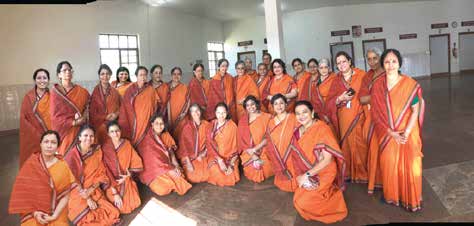
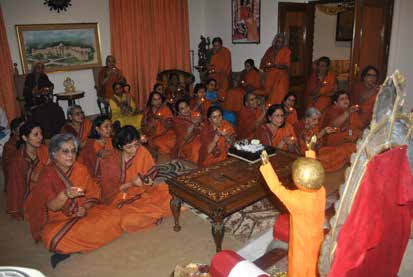
Cover pictures
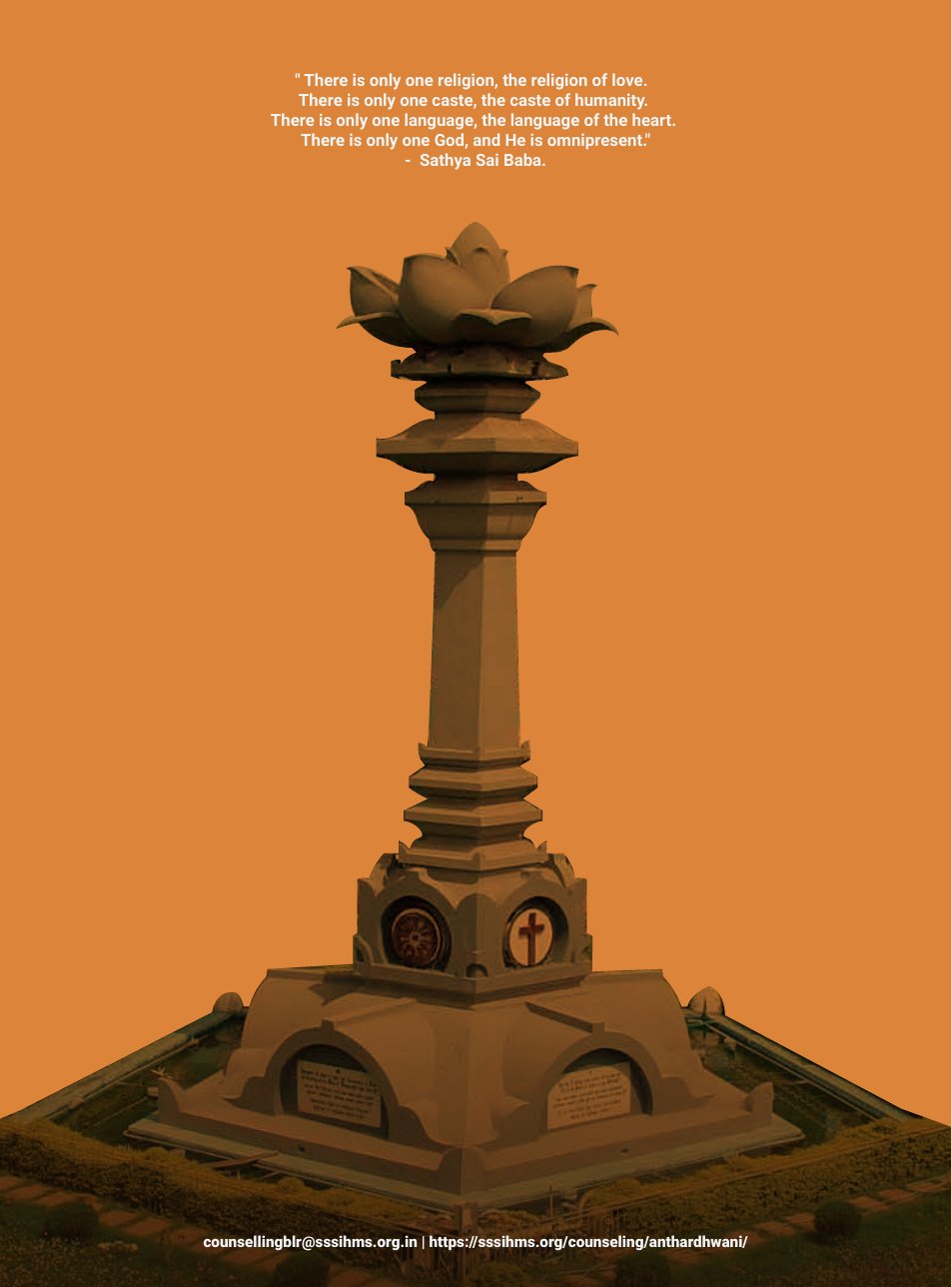
Pictures used on the covers and contents page